
Why Your Dog Falls Apart When the Kids Go Back to School (And What Actually Helps)
Bruno cannot read a calendar.
Our pit bull rescue has no idea what a school year is, could not tell you the difference between June and September, and has never once checked a clock. What he can do, with terrifying accuracy, is clock the exact second the routine changes.
That is the whole problem in one sentence. Dogs do not track dates. They track patterns.
And in the next couple of weeks, the pattern in your house is going to change harder and faster than it has all year.
All summer your dog has been living the dream. People home at strange hours. Kids in and out the back door forty times a day. Somebody parked on the couch at two in the afternoon. Snacks hitting the floor at a rate that can only be described as generous.
Then one Tuesday morning, everybody leaves at 7:30 and nobody comes back until 3.
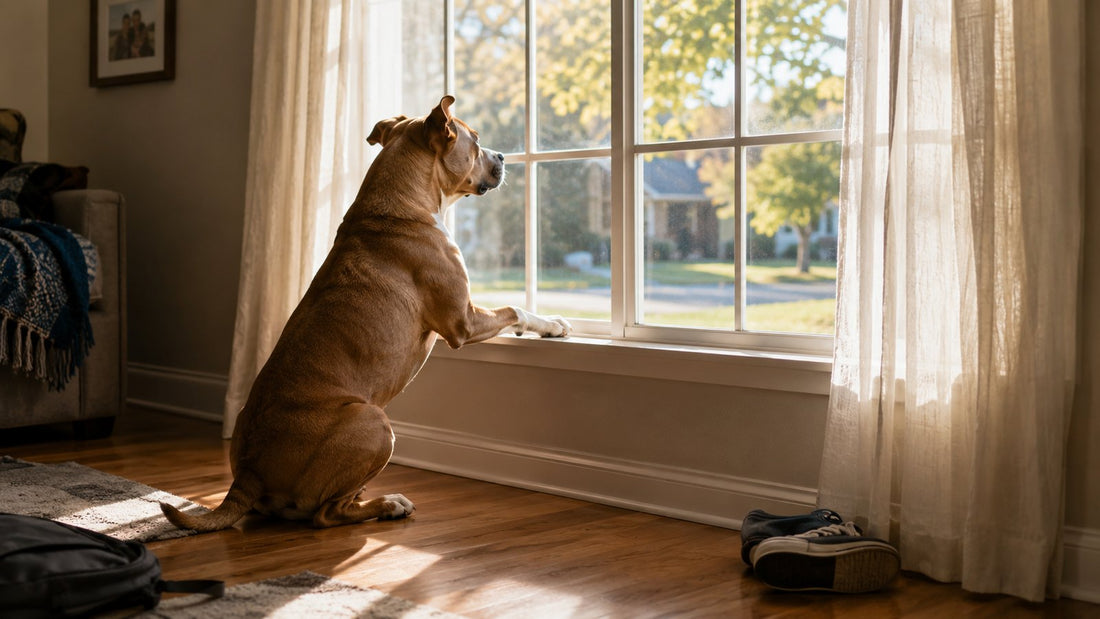
From your dog's side of it, the family just vanished.
Here's the good news: this is one of the few dog problems you can see coming. You know the exact date. Which means you can get out in front of it instead of cleaning up after it.
The short version
- Dogs track routine, not dates. Back to school is the single biggest change to that routine all year, and it lands overnight.
- Watch for pacing, whining, shadowing you room to room, accidents from a fully house-trained dog, chewed door frames, and barking that starts within minutes of the door closing.
- Most dogs are having a rough two weeks, not a medical crisis. True separation anxiety is a diagnosable condition, and it needs a veterinarian or a veterinary behaviorist, not a blog post.
- Start now. Practice the new schedule before it goes live.
- Make your leaving boring, give your dog a job for the first thirty minutes, and fix the afternoon instead of only fixing the morning.
Why do dogs get anxious when the kids go back to school?
Dogs get anxious at back to school because their routine changes overnight and their favorite people disappear on a schedule they do not understand. All summer the house was full and unpredictable in a fun way. Then it empties out, at the same time, every single day. Your dog does not know it is temporary. He just knows the pack left.
Two things stack on top of each other here.
The first is the loss of company. If your dog spent ten weeks with a kid attached to him, that kid leaving is a real loss, not a small one.
The second one people miss: the loss of stimulation. Summer is loud. Summer is chaos. Summer is a hundred small events a day. September is a quiet house and a nap. That drop in activity is a big deal for a dog, and a bored dog and an anxious dog often look identical from the outside.
What does back to school anxiety look like in a dog?
The tell is timing. Anxiety around departure shows up in the first fifteen to thirty minutes after you walk out the door. If your neighbor says the barking started right after you left and ran for an hour, that is your answer.
Things owners report every single fall:
- Pacing and panting while you are still getting ready. Dogs read the keys, the shoes, and the backpack long before they read the door.
- Shadowing. Following one person room to room, including the bathroom, which was cute in July and is a signal now.
- Accidents from a dog who has been reliably house-trained for years. This is not spite. Nobody is getting even with you.
- Destructive chewing, usually at exits. Door frames, window sills, blinds, the trim by the back door. Chewing at an exit point is not the same as chewing a shoe on the rug.
- Barking or howling that starts within minutes of the door closing.
- Not eating while alone, then wolfing it down the second you walk in.
- Falling apart at pickup time. Some dogs are fine at 8 a.m. and coming unglued at 2:45.
It happens to good dogs with good owners.
Is it separation anxiety or just a rough couple of weeks?
Separation anxiety is a real clinical condition, and it is not the same thing as a dog having a hard time adjusting. Most dogs in the first two weeks of September are adjusting. A smaller number have genuine separation anxiety, and those dogs need actual help.
A rough adjustment looks like: some whining, some restlessness, a couple of bad days, and steady improvement over one to two weeks as the new routine sets in.
Real separation anxiety looks like panic. Not sadness, panic. Drooling to the point the floor is wet. Injuring themselves trying to get out of a crate or through a door. Bloody paws or a broken nail from digging at an exit. Vomiting or diarrhea every single time. And critically, it does not get better on its own. It gets worse.
If you are seeing the second list, stop reading and call your vet. Ask specifically about a referral to a veterinary behaviorist. That is a board-certified specialty and those folks are very good at this. There are medications that help in real cases, and there is no medal for white-knuckling it.
Devil Dog Pet Co carries chews. We are not your dog's behavior team, and I am not going to pretend a bully stick fixes a panic disorder.
For everybody else, and that is most of you, here is the plan.
What actually helps a dog with back to school anxiety?
1. Start the new schedule before the new schedule starts
This is the highest-leverage thing on this page and it costs you nothing but a little planning.
Do not let day one be the first time your dog experiences the new normal. For the next week or two, run a rehearsal. Get up closer to the school-day time. Feed at the school-day time. Walk at the school-day time. Then leave the house for twenty minutes and come back. The next day, forty. Then an hour.
You are teaching one lesson, over and over: people leave, and people come back. Boring, repeatable, and it works.
2. Make your leaving boring
The single most common mistake I see is the long, emotional goodbye. Hugging the dog, big voice, "we're gonna miss you buddy," the whole show.
That is a signal flare. You just told your dog that something significant is about to happen.
Instead: get ready, leave, say nothing or almost nothing. Same when you get home. Come in, hang up the keys, let the dog settle for a minute, then greet him. Low-key in, low-key out.
The easiest fix I know: start picking up your keys and putting them back down at random times of day when you are not going anywhere. Put your shoes on and then make coffee. Grab the backpack and sit on the couch. Ten seconds at a time, you are breaking the association between those cues and being left alone.
3. Give them a job for the first thirty minutes
That first half hour after the door closes is the window that matters. If your dog is occupied through it, most of the time he settles into a nap and the day is fine.
This is not a distraction gimmick. Chewing is genuine self-soothing behavior for dogs; it is one of the ways they work through stress on their own. A long-lasting chew handed over while you are getting ready gives all that energy somewhere useful to go, and it turns your departure into the moment something good happens.
More on picking the right one below.
4. Work the body first
A walk before everybody scatters changes the whole morning. Not a lap around the yard; a real walk with sniffing time, because sniffing tires a dog out faster than distance does.
A tired dog going into an empty house is a completely different animal than a fresh one.
5. Fix the afternoon, not just the morning
Everybody plans the morning and forgets the back half of the day. Your dog might be perfectly fine at 8 a.m. and coming apart at 2 p.m., because that is when the house used to fill back up.
Options that work: a midday walk from a neighbor, a friend, or a walker; a stuffed and frozen food toy; a second chew saved for the afternoon; a radio or TV left on so the house is not dead silent.
You do not need all of them. Pick one.
6. Put the kids to work
Give the kid a ten-minute job with the dog before school and ten minutes after. A walk, a training session, a game of find-it with treats hidden around a room.
Two things happen. The dog gets a predictable piece of that person back, and the kid gets a routine that makes the transition easier on them too. That part is not nothing.

What does not help
Long emotional goodbyes. Covered above. You are making it worse with the best intentions in the world.
Punishing the mess. Coming home to a chewed door frame is infuriating. I get it. But a dog who panicked four hours ago has no idea why you are angry now, and scolding an anxious dog just adds you to the list of unpredictable things. Clean it up and fix the cause.
Getting a second dog to fix the first dog. This is one of the most expensive mistakes in dog ownership. A dog with separation anxiety is attached to you, not to canine company in general. Most of the time you end up with two dogs and the same problem.
Waiting to see if it works itself out. Two weeks of gradual improvement is normal. Four weeks of getting worse is a signal. Do not wait until December.
What is the best chew to leave with a dog during the day?
"Give them a job" only works if the job takes a while. A chew your dog finishes in ninety seconds is not a job; it is a snack.
Here is how we match them up at Devil Dog Pet Co.
Elk antlers are the hardest and longest-lasting natural chew we carry. Wild sourced and naturally shed in the Rocky Mountains, Grade A inspected, and hand-selected before they go in the box. Whole antlers are the toughest option and the right call for a serious Power Chewer. Split antlers expose the marrow, so dogs get into them immediately, which matters when you need engagement in that first thirty minutes. Seven sizes from Small to Beast, so there is a fit for a beagle and a fit for a mastiff.
Himalayan yak chews are the workhorse, and they are the one I hand out most for this exact problem. Hard, dense, long lasting, and completely odor free, which matters more than people expect when a chew is going to sit on the living room rug all morning. Five sizes from Small to Beast.
Here is the part most owners do not know. When a Devil Dog Pet Co yak chew wears down to a nub too small to keep chewing safely, do not throw it out. Put the nub in the microwave and it puffs up into a light, crunchy cheese puff in about a minute. Same chew, second life, and it makes a great after-school moment for the kids. Our Himalayan Yak Cheese Puff Nuggets run on the same principle; they ship as hard yak cheese nuggets and you microwave them at home to puff them.

Bully sticks are single ingredient, grass-fed, and fully digestible, which is what you want for a dog who is going to work through the whole thing. Three types, Standard, Jumbo, and Braided, each in 6 inch and 12 inch.
If you have a small dog and you have been told there is nothing long lasting that fits, that is not true. A 6 inch Standard is a real chew scaled to a smaller jaw, and it is exactly what I would hand a fifteen-pound dog on a Tuesday morning. Braided is the one to reach for when a Standard disappears too fast, since three strands twisted together take a lot longer to get through than one.
Beef collagen sticks are the newest chew we carry, and they are not a replacement for a bully stick. A bully stick is beef pizzle, which is muscle. A collagen stick is beef corium, the connective tissue layer underneath the hide. Different protein, different texture, different chew.
Two things make them a strong fit for this particular job. They are low odor, which counts for something when a chew is going to sit in your living room for two hours in a house with nobody in it. And they are new, which sounds trivial and is not: the whole mechanic here is making your departure the moment something good happens, and a chew your dog has never seen before does that better than the one he has been getting all summer.
Single ingredient, sourced from South America, fully digestible end to end. 12 inch for bigger dogs, 6 inch for smaller ones.
Right now beef collagen sticks are on Amazon. They come to devildogpetco.com this fall.
Shop beef collagen sticks on Amazon
Not sure which one? The Tough Chew Crew Pack has the lineup in one box so you can find out what your dog actually prefers instead of guessing.
Two safety rules, every time. Supervise your dog with any chew, and take it away once it gets small enough to swallow. Yes, that means the morning routine has to account for that. If nobody is home to supervise, a stuffed and frozen food toy is the safer choice for the hours your dog is alone.
If you want the longer explanation of why chewing matters this much to dogs, we wrote that one up here: Why Do Dogs Like to Chew? The Real Reasons Behind It

Shop all long lasting dog chews
Back to school dog anxiety FAQ
How long does it take a dog to adjust to a new schedule?
Most dogs settle into a new routine within one to two weeks, and you should see steady improvement day over day. If your dog is worse in week four than he was in week one, that is not an adjustment period. Call your vet.
Should I get a second dog so mine is not lonely?
Almost never for this reason. Separation anxiety is about attachment to you, not general loneliness, and a second dog usually means two dogs with the same problem. Get a second dog because you want a second dog.
Is it separation anxiety or boredom?
Timing tells you. Anxiety shows up in the first fifteen to thirty minutes after you leave, and it centers on exits: doors, windows, crates. Boredom shows up later in the day, spreads out around the house, and looks more like entertainment than panic.
Can I leave a chew with my dog while I'm at work?
Not unsupervised. Any chew can become a choking hazard once it gets small enough to swallow. Give the chew while you are still home getting ready, then take it before you walk out. For the unsupervised hours, use a stuffed and frozen food toy rated for solo use.
What is the best long lasting chew for a small dog?
A 6 inch Standard bully stick is the one I would start with; it is a genuine long-lasting chew sized for a smaller jaw. A Small split elk antler and a Small yak chew both work well too, and a 6 inch beef collagen stick is a good option if you want something with lower odor for indoors. Small dogs are not stuck with soft treats.
What is the difference between a bully stick and a collagen stick?
A bully stick is beef pizzle, which is muscle tissue, and it has a stronger flavor that a lot of dogs love. A collagen stick is beef corium, the connective tissue layer under the hide, with a firmer texture and lower odor. Both are single ingredient and both are fully digestible. Neither one is better; they are different chews for different dogs and different rooms of the house.
My dog is having accidents in the house again. Is he mad at me?
No. Dogs do not do revenge. House-training breaking down under stress is a well-documented stress response, and it is worth a vet visit to rule out a urinary tract issue before you chalk it up to behavior.
Does leaving the TV or radio on actually help?
For some dogs, yes. It masks outside noise and makes the house feel less abandoned. It will not fix real separation anxiety on its own, but as one piece of an afternoon plan it is free and it does no harm.
Should I crate my dog while the kids are at school?
If your dog already likes the crate and rests in it willingly, it can be a calm, safe place. If your dog panics in a crate, forcing it makes everything worse and creates a real injury risk. A dog who tries to escape a crate is telling you something; listen to him.
When should I call a vet?
Call if you see drooling that soaks the floor, self-injury from trying to escape, vomiting or diarrhea every time you leave, or symptoms that are getting worse instead of better after a few weeks. Ask about a referral to a board-certified veterinary behaviorist.
Your dog is not being dramatic and he is not being difficult. His entire world just got quiet, and nobody explained why.
Give him two weeks, a predictable routine, and something worth doing in that first half hour, and most of this sorts itself out. Start this week and it barely happens at all.
Good luck with the first day. Take a picture of the kids at the door, and one of the dog watching them go. You will want both.
About the author: John Balcazar is the President and Co-Founder of Devil Dog Pet Co, a veteran-owned, family-operated company in Sterling Heights, Michigan that carries premium natural chews: elk antlers, Himalayan yak chews, bully sticks, and beef collagen sticks. Battle Tested, Dog Approved.
This article is for educational purposes and isn't a substitute for veterinary advice. Separation anxiety is a diagnosable medical and behavioral condition; if your dog shows signs of panic, self-injury, or symptoms that worsen over time, contact your veterinarian or ask for a referral to a board-certified veterinary behaviorist. Sources: American Kennel Club, ASPCA, American Veterinary Society of Animal Behavior, Merck Veterinary Manual.