
A Fall Enrichment Routine for the Shorter Days Ahead
We're already losing daylight fast here in Michigan. September alone takes more than an hour off the day. Walks get shorter, it's dark by dinner, and your dog's got the same gas in the tank he had in July.
Here's what I'd tell you to do about it: two quick sniff games and one chew session a day, and rotate the chew during the week. Fifteen minutes, give or take. It fills the hole the long walks leave behind, and it's easy enough that you'll still be doing it in January.
The short version
- Your dog's day gets smaller in the fall. Your dog doesn't. The energy has to go somewhere.
- Morning: five minutes of scatter feeding before the walk.
- Afternoon: five minutes of "find it."
- Evening: one supervised chew session, 20 to 30 minutes, same time every night.
- Rotate the chew through the week so it stays interesting, and put it away between sessions.
What actually changes for your dog in the fall?
Your dog didn't get the memo that the schedule changed. The evening walk gets cut short because it's dark. The after-dinner yard time is gone. You're inside more, so they're inside more, and all that energy still has to go somewhere. Usually it goes into pacing at 7 p.m., barking at the window, or a shoe.
It isn't your dog being bad. It's your dog being bored. A bored dog needs a job, and giving them one is on us, not them.

Left: 7 p.m. with nothing to do. Right: 7 p.m. with a chew.
What does a fall enrichment routine for a dog look like?
Morning: five minutes of sniffing before the walk
Grab a handful of your dog's regular kibble and scatter it across the yard, the porch, or a rug in the hallway. Let them hunt for it. That's it.
Sniffing does a lot more than people think. A study out of Barnard College's Dog Cognition Lab (Applied Animal Behaviour Science, 2019) had one group of pet dogs do two weeks of daily nosework and another group do two weeks of heelwork. The sniffing dogs came out more optimistic on a standard behavior test. Not more tired. More optimistic. Let your dog use his nose and you're changing his mood, not just wearing him out.
Do it before the walk, not instead of it.
Afternoon: the "find it" game
Five more minutes, sometime in the afternoon. Show your dog a piece of kibble, have them sit and wait, hide three or four pieces around the room, then let them go with "find it."
First week, hide them where the dog can see them. Second week, behind a chair leg or under the edge of the rug. Third week, add another room. If you don't feel like crawling around your living room, a snuffle mat does the same thing.
If you read the back to school post, this is the same game. It works in September for the same reason it worked in August.
Evening: the chew session
This is the one that matters most.
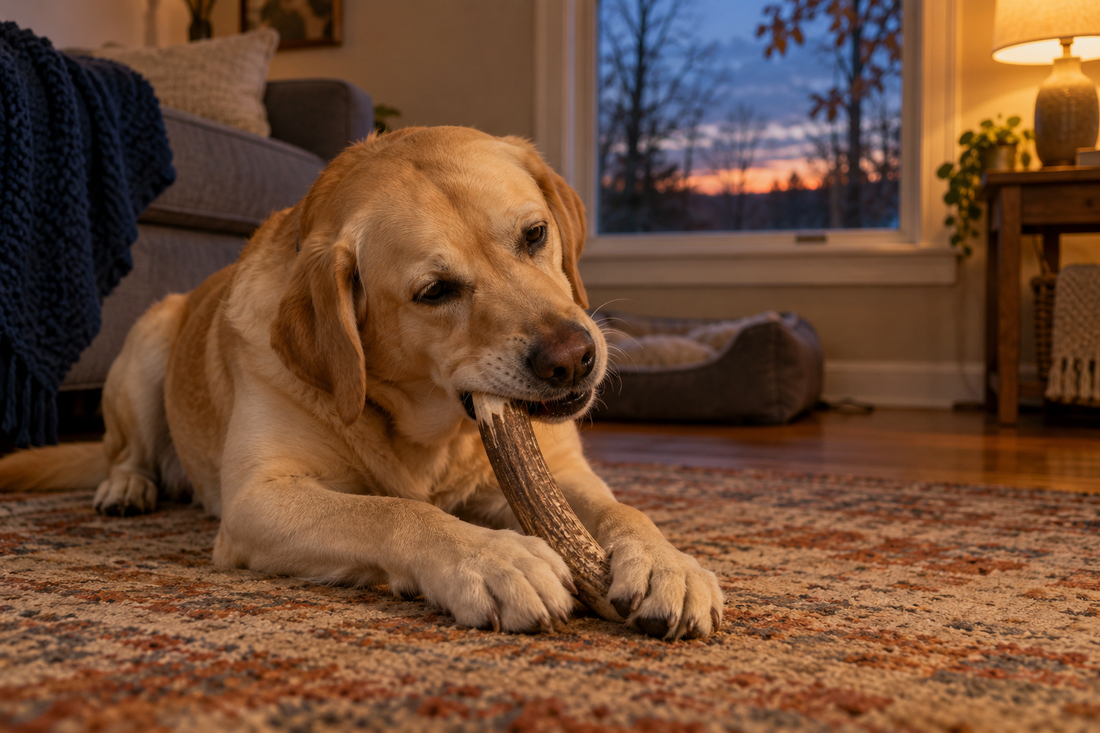
After the evening walk, same time every night, give your dog one long-lasting chew and sit with them for 20 or 30 minutes. When you're done, the chew goes back in the drawer. Not on the floor. In the drawer.
Most dogs chew and then settle, and that's why this goes at the end of the day. Twenty minutes on a whole elk antler is real work. You'll see it in the jaw and the neck.
A chew that's always on the floor gets ignored. A chew that only comes out at 7 stays interesting.

Which chews should you rotate?
Same chew every night and your dog gets bored of that too. Switch it up. Here's how the rotation works with what we carry at Devil Dog Pet Co.
Whole elk antlers are the hardest natural chew we carry and the one for Power Chewers and Destroyers. This is your longest weeknight session. Split elk antlers are the way to start on antler: the marrow is exposed, so dogs get into them right away, and they're the right call for moderate chewers, seniors, and puppies who have their adult teeth.
Himalayan yak chews are dense, fully digestible, and completely odor free, which is why they're the indoor night chew. Work-from-home days, sensitive stomachs, nights you don't want anything on the couch.
Bully sticks are softer, edible, and dogs go nuts for them. Use them for short sessions, as the training reward all week, and for dogs who aren't sold on chewing yet.
A week that works for most dogs:
- Monday, Wednesday, Friday: elk antler (whole for Power Chewers, split for everybody else).
- Tuesday, Thursday: yak chew.
- Saturday: bully stick, after a longer sniff walk while it's still light out.
- Sunday: put two chews down, let your dog pick, put the other one away.
If you don't know your dog's chew strength yet, figure that out first: Light-Gnawer, Moderate-Focused, Power-Strong, or Destroyer. And when you're not sure on size, go bigger. The weight guidance is on every product page.

Don't throw out the yak chew nub
When a yak chew gets down to the last inch or two, don't toss it. Put it on a plate, microwave it for 45 to 60 seconds, let it cool for a couple minutes, and hand your dog a crunchy cheese puff. Nothing wasted, and no little piece to worry about.

Three fall mistakes
Skipping the walk because it's dark and putting nothing in its place. If the walk shrinks, the games and the chew session have to grow. This isn't extra. It's the replacement.
Buying treats for the games. You don't need them. Both sniff games run on the kibble you're already feeding. Take it out of the bowl and put it in the game. Same food, more work.
Handing over the chew and leaving the room. That's a safety problem first. It also skips the whole point, which is your dog learning that this time of night is for settling in next to you.
Make it automatic
This routine dies the first Tuesday you open the drawer and it's empty.
That's what the Tough Chew Crew Pack is for. Elk antlers, yak chews, and bully sticks in one box, sized to your dog's weight from Private (up to 20 lbs) to General (75 lbs and up). Put it on Subscribe & Save and the next box shows up before you run out.
Build your dog's rotation with the Tough Chew Crew Pack
Shop all long lasting dog chews
Fall dog enrichment FAQ
How much enrichment does a dog need in the fall?
For most adult dogs, two five-minute sniff games and one supervised 20 to 30 minute chew session a day is a baseline you can actually keep up all winter. Adolescents, working breeds, and high-drive dogs need more on top of that, and a longer sniff walk on the weekend covers a lot of it.
Can a chew replace a walk?
No. It covers the mental side of a longer walk on the days you can't get one in. Your dog still needs to move.
Which dog chew lasts the longest?
Whole elk antler, by a lot. Yak chews run about four to seven days for light chewers, two to four days for moderate chewers, and one to three hours for Power Chewers. A bully stick is a one-session chew.
Can puppies do this routine?
The sniff games, yes, at any age. The chew session starts once the adult teeth are in. Split elk antlers and yak chews are the easier starting point. Check the age guidance on the product page.
What if my dog ignores the chew?
Start with a bully stick to get him interested, only bring chews out at session time instead of leaving them around, and rotate. Chews that are always out get ignored.
The days are going to keep getting shorter until December. Your dog's energy isn't going anywhere. Give him two sniff games and a chew every day and the dark evenings stop being a problem.
It's our honor to serve you and your pups.
About the author: John Balcazar is the President and Co-Founder of Devil Dog Pet Co, a veteran-owned, family-operated company in Sterling Heights, Michigan that carries premium natural chews: elk antlers, Himalayan yak chews, bully sticks, and beef collagen sticks. Battle Tested, Dog Approved.
This article is for educational purposes and isn't a substitute for veterinary advice. Always supervise your dog with any chew, provide fresh water, and remove the chew once it's small enough to swallow. If your dog's restlessness looks like panic rather than boredom, talk to your veterinarian. Source: Duranton, C., and Horowitz, A. (2019). Let me sniff! Nosework induces positive judgment bias in pet dogs. Applied Animal Behaviour Science, 211, 61 to 66.